Rules create the framework 

National laws, European regulations, international rules: DFS operates within a tight legal framework. The level of air navigation charges we levy for our services is fixed by regulation, for example. For certain core areas, DFS must also meet predefined targets.

DFS is a company organised under private law (GmbH) and wholly owned by the Federal Republic of Germany. Our task is to control air traffic in Germany in a safe, orderly and expeditious manner. This is what the German Aviation Act (LuftVG) demands. Section 27c(1) lists the tasks of air navigation services and is the legal basis for our work.

However, the legal framework within which DFS operates is much more comprehensive. It includes the rules defined by the International Civil Aviation Organisation (ICAO). They play a role in the planning of approach and departure routes, for example. In addition, there are various European regulations that aim to introduce a Single European Sky. They have considerable influence on the work of air navigation service providers.

One result of European legislation has been the establishment of the German Federal Supervisory Authority for Air Navigation Services (BAF), which has certified DFS as an air navigation service provider and monitors our work. Another consequence is that DFS has had to meet defined performance targets since 2012. Since then, target values have been agreed in terms of safety, punctuality, route efficiency and costs, which guide us in our work.


airplane at cruising altitude


How DFS finances itself 

Airlines pay charges to DFS to guide their aircraft safely to their destinations. These air navigation charges are incurred for every take-off and every flight through German airspace. Terminal charges depend on the maximum take-off weight of the aircraft (see charges calculator). En-route charges are incurred as soon as an aircraft crosses the airspace. When crossing airspace, in addition to the weight, the length of the distance travelled is considered in these charges.

DFS does not set air navigation charges at its own discretion: The charges are regulated by European legislation; they are set at national level for terminal services, and at European level for en-route services.

To incentivise the performance of air navigation service providers (ANSP), the European legislator has stipulated the following: If the income from charges exceeds their costs, ANSPs are allowed to keep all or part of it. Conversely, they have to bear part of the risk if the costs are higher than the income. Planning is based on traffic forecasts. If any fluctuations in the traffic volumes fall outside the specified forecast range, DFS must raise or lower the charges with a two-year delay.

Charges are the main source of revenue for DFS. However, they only make up a small part of the ticket price. Before the COVID-19-related slump in air transport, this was around €2.50 per passenger.

Find out more.


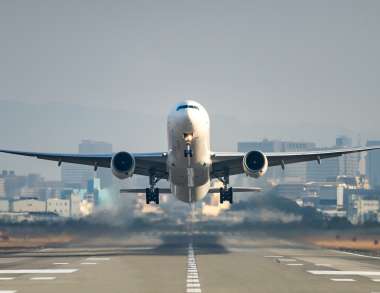
airplane taking off


Charges
calculator

Please enter the weight of your aircraft in kilogrammes and press "=":

kg